
BUILT FOR PERFORMANCE. BUILT FOR YOUR BOAT.
50+ Years of Client Focus
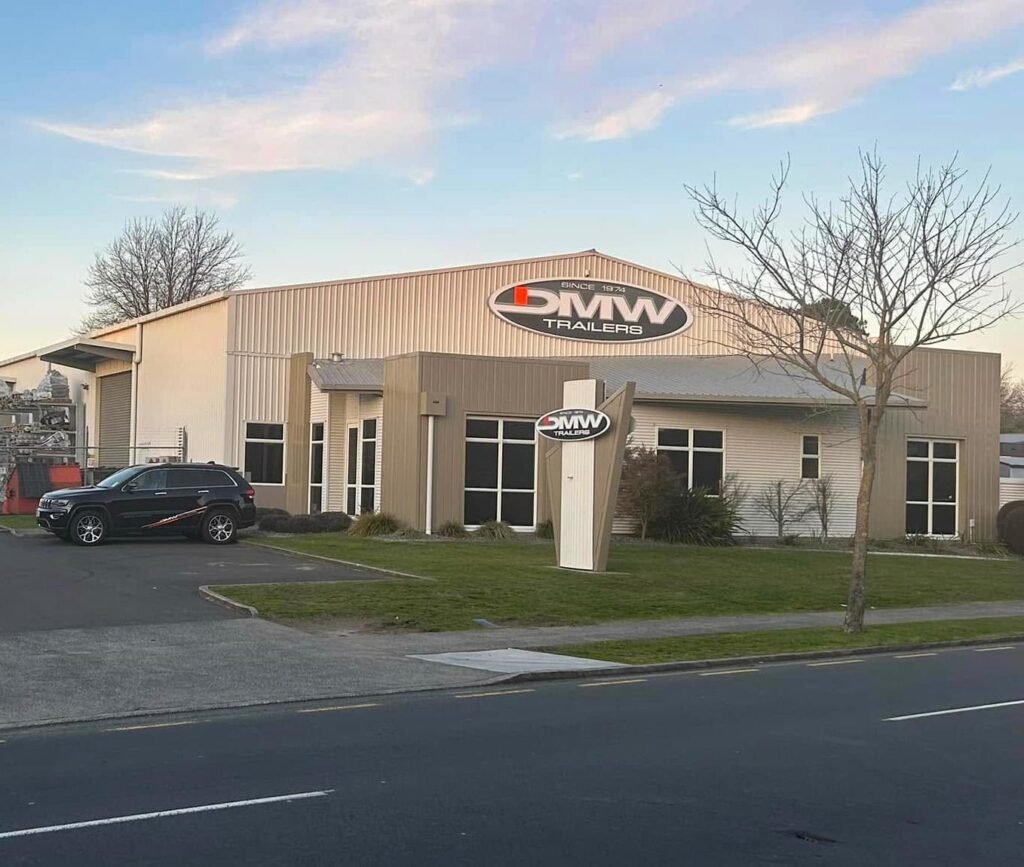
DMW Trailers are manufactured at our purpose-built factory in Hamilton to the highest standard of quality. Established in 1974, Our 50+ Year reputation for innovative and functional design has placed DMW Trailers amongst this country’s longest standing and leading trailer manufacturers.
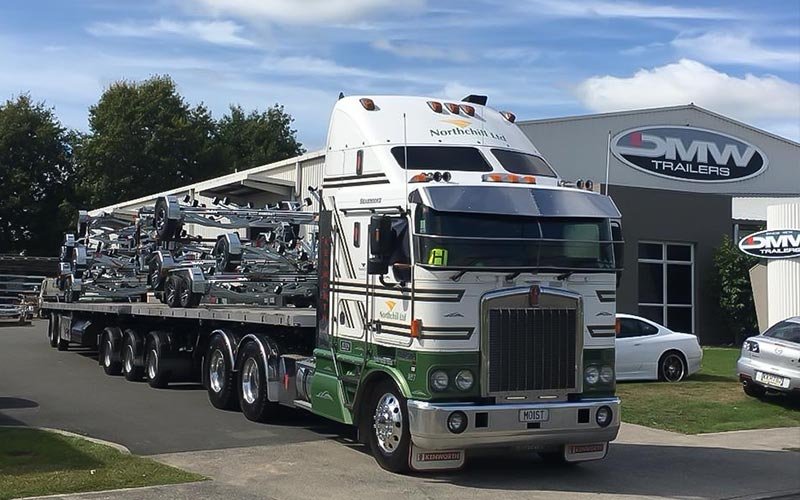
We specialise in building, from Jetski and small aluminium boat trailers, through to trailers for the largest trailerable boats. Our range of Premier Series Multiroller Trailers are custom built to suit most boat brands and models, and are held in high regard in the marine industry.
DMW Trailers apply a 5 Year Structural Warranty on the chassis and a 1 Year Warranty on all components.
We manufacture for re-sale through boat manufactures and dealers throughout New Zealand and also for the export market.
DMW Trailers use quality Trojan trailer components and all parts and accessories used, meet the high standard required, these spare parts are also all available from our factory along with friendly customer service.
DMW Trailers also specialise in general trailer repairs, refurbishing, regalvanising and W.O.F work. The installation of, and overhaul of, braking systems, from override (under 2500 kg) to the hi-tech Sensabrake and Brake Commander Electric over hydraulic (over 2500 kg), are all part of our service.
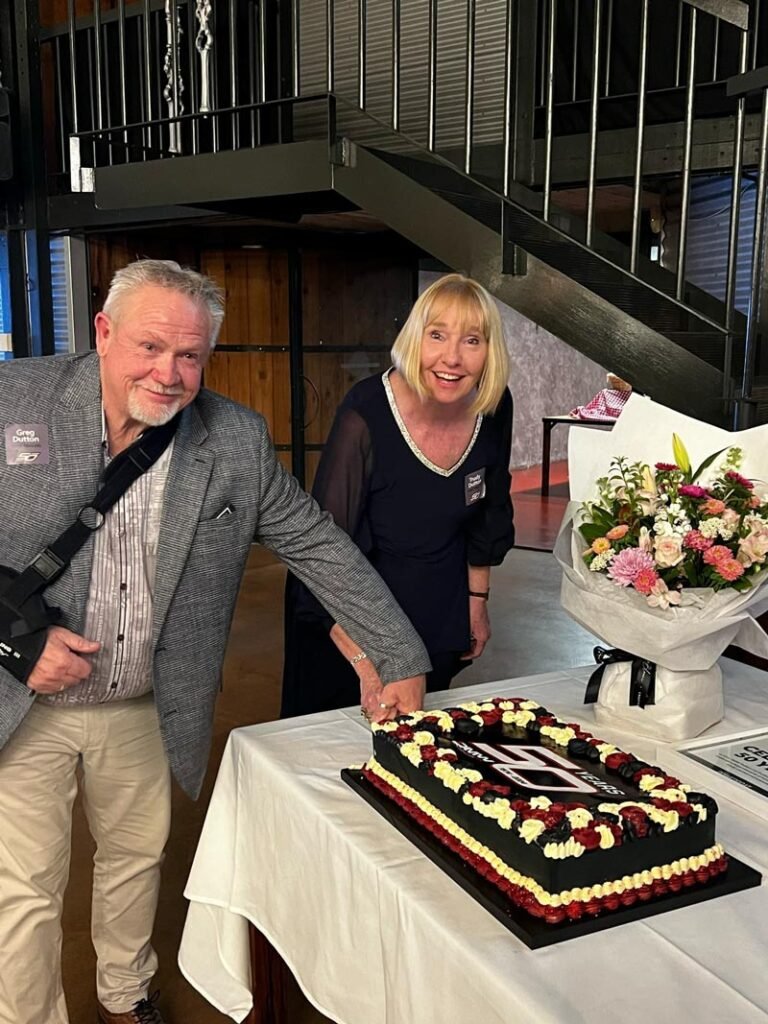
In May 2016, Company Director Greg Dutton was inducted into the NZ Boat Show Hall of Fame for his 40 years of contribution and service to the NZ Marine industry and the Hutchwilco NZ Boat show. This is a huge achievement and one of the highest accolades in the NZ Marine Industry.
DMW Trailers are also NZ Marine Members.
2016
NZ Boat Show Hall of Fame
In May 2016, Company Director Greg Dutton was inducted into the NZ Boat Show Hall of Fame for his 40 years of contribution and service to the NZ Marine industry and the Hutchwilco NZ Boat show.
This is a huge achievement and one of the highest accolades in the NZ Marine Industry.
The DMW Trailers Team

Greg Dutton – Managing Director
Greg has been in the marine industry for over 50 years and the majority of this time has been at the helm of DMW Trailers. He was a pioneer of the multi roller trailer design which DMW now call their Premier Series. Greg and his wife Trudy have been owners of the company since 1983. Greg has an amazing knowledge of not only trailers but also the boats from all different eras. When he is not at work Greg likes to be on the water in his 24ft Mason Clipper that he has restored or driving race boats in the sport of water ski racing which he has participated in for 35 years. He also enjoys driving his race car in the BMW Open Class when he gets a chance. Greg is a member of the NZ Boat Show Hall of Fame and Life Member & Hall of Famer in the NZ Water Ski Racing Association.

Trudy Dutton – Administration / Director
Trudy has been married to Greg since 1983 and is a long time Director of DMW Trailers while being a stay at home mum while their 2 kids were growing up. Trudy now has a commanding role working at DMW looking after Health & Safety and accounts payable and generally ensuring everyone is doing as they should. She loves looking after and playing with her grand children who she dotes over.

Brad Dutton – Sales & Marketing
Brad is the son of Greg & Trudy and has been working in the Marine Industry since he left school. He has a Business Management Degree majoring in Marketing and HR.. Brad has been working at DMW since 2015 and is now a shareholder of the business. Brad is married to Kristen and has 2 boys, Ryder & Laken, who likes spending plenty of time with. He also likes getting out on the water whether is it is competing in water ski racing as a driver, skier or observer or just socially going out for a ski or cruise.
Matt Ward – Logistics, Dealer Sales
Matt is the Brad’s 2nd in charge and ensures everyone is receiving their trailers when they require them. Matt looks after a group of dealers and boat builders and makes sure we deliver the right trailers at the right time. Matt likes staying fit and active and boating up in the Bay of Islands with his family.

Krystal Downey – Administration Manager
Krystal is the bubbly voice on the end of the phone when you ring DMW Trailers. Krystal looks after all the invoicing, accounting and administration side of the business, she has plenty of experience in manufacturing accounting and she enjoys the vintage lifestyle, wowing us each and every day with her bright, bold hairstyles and outfits.
Dannelle Corin – Administration Assistant, Parts & Freight
Trailering Tips
When hooking up
Before you put the trailer on the tow ball check first that there are 3 points of contact securing your boat to your trailer. All boats should be connected to their trailers via safety chain, winch rope hook or turnbuckle, at the front and tiedowns at the rear. Tiedowns must be used by law so make sure these are in sound condition, we believe the ratchet type to be the most reliable. Your winch safety chain needs to be firm with very little or no slack forward when your boat is winched hard into your snubber, this means the front of the boat can’t bounce up and down in the snubber which ensures it will be effective in a crash stop situation and prevents the need for a rope or similar on the bow of the boat. If everything is tight it means for a solid secure load which is safer and nicer to tow. A second means of attachment like a turnbuckle is also good as you won’t be wearing out the bearings and gears in your winch while you are travelling.
When you go to put the coupling on the tow ball you need to ensure your ball size on your vehicle matches your coupling. A lot of our trailers have multi fit couplings that are 50mm when the handle is turned to the left and 1 7/8 on the right. Make sure this is selected to correctly match your ball. A rough rule of thumb for draw bar down weight is between 5-10% of the total weight of the rig.
A coupling lock or padlock through the coupling is a great form of security that is easy to apply and a bit of peace of mind when the trailer is sitting at the boat ramp while you were out boating. Most insurance companies request some means of security to guarantee their insurance – in a lot of cases this is a wheel clamp.
Make sure you hook up both your safety chain and trailer light plug and your jockey wheel is securely folded away. Ensure the jockey wheel is wound all the way up as a lot of jockey wheels locate when they are all the way up and this helps the jockey not flop down when travelling. Another tip is to poke your trailer plug through the handle of the coupling, so that if it does happen to come out of the female plug on your vehicle for any reason, then it won’t drag on the road.
If your trailer has 2 safety chains (2000kg & above) these need to be crossed and connected to opposite sides of the tow bar.
It is also a good time to ensure your handbrake on the trailer (if you have brakes) is off so you don’t attempt to drive off without realising this.
If any part of your boat or engine exceeds 1m from the rear of your trailer or specifically your trailer lights, you are required by law to have a prop flag or something similar attached. If you are travelling at night you are required to have a flashing light attached also. Remember, you also need to have a light directed at your number plate – DMW Trailers have this built into the rear facing LED lights which is why we hang our number plates underneath the lights.
At the Ramp
Firstly, make sure you remove your tie downs and prop flag.
Leave your winch safety chain on until you have backed down the ramp, and are ready to launch. Once the boat is in the water, unwind your winch slightly to let the weight off your safety chain. Remove the chain and then let the boat roll back with the winch still connected so you maintain control over the boat and then remove the winch hook. It is a good idea to either have a bow rope attached or someone in the boat at this point to keep the boat from getting away on you.
On retrieval you don’t need to back the trailer in too deep. It is all dependent on the angle/incline of the ramp, but in most cases the water level up 2/3’s of the way up your wheel is plenty.
Put your safety chain on as you are winching the boat onto the trailer, this is for 2 reasons – so you don’t forget and it is often difficult to attach the shackle once the boat is pulled hard into the snubber.
Once the boat is out of the water remember to trim your motor up ready for travel, re attach your tie downs and prop flag and fold down and put away things like aerials and fishing rods that could snag on overhanging trees or the likes.
If you have a braked trailer, this is a good time to flick the reverse lock lever that allows the brakes to be applied.
Maintenance Tips
The MORE fresh water the better!
Always wash all of the trailer with lots of fresh water after use in salt water. This could mean washing trailer whilst washing the boat, or if possible, submersing the trailer into a freshwater lake or river this is an even better way of rinsing all of the trailer and components including the inside of the RHS side frames/cross members etc. The inside of the chassis and cross-members can be cleaned out by inserting a hose into the drain holes. It is even a good idea to have a bottle of water in your vehicle that you can quickly spray over the most critical areas after you have launched your boat before you go out boating for the day. The sun baking the salt onto your trailer and its components for 6-8 hours while you are on the water is where a lot of the damage is done. The MORE fresh water the better!
Galvanizing
The galvanised coating on every DMW Trailer is made up of mainly zinc and is an anode just like the ones you see attached to your outboard engine or sterndrive. It means the galvanised coating is sacrificial to the steel it protects. This coating will slowly deteriorate and break down in the presence of an electrolyte such as saltwater.
This is why the galvanising will lose its shine after a short period of time. It’s doing its job of protecting the steel chassis and components. If left unwashed, the zinc coating will eventually disappear.
Keep an eye on your suspension
Suspension units, either Springs or Duratorques need to be checked regularly, Springs for cracks in the leaves or worn hangers or slippers, Duratorques whilst not needing too much in the way of maintenance, like springs need to be checked for corrosion deterioration.
Keep Pressure in those Tyres
Tyres must be checked on a regular basis for damage or deterioration; pressures must be checked often and kept up to the high side of manufacturer’s recommendations. Under inflated tyres will cause sidewall damage and the tyres to wear out quicker than they should. In most cases we fit light truck tyres that can be inflated higher than regular car tyres. Check the sidewall of the tyre or the DMW serial plate for the correct inflation pressure of your tyres. A good idea is to be within 5 PSI of the maximum pressure especially when your boat is loaded up full of gear.
Look after what’s stopping you
Brakes need special care, these are important to safety, for you and your investment, our recommendation is that when you get your WOF, you should strip, clean, check, re-grease all caliper parts as a matter of course, as preventative maintenance, this is to avoid the chance of seizure, a “cooked up” hub can be a real inconvenience miles from anywhere, and also expensive as well.
DMW Trailers fit and supply as standard Stainless steel calipers. We recommend Stainless Steel Rotors (discs) and hoses for new trailers and also aftermarket fitments, whilst these are more expensive they are far more reliable and corrosion resistant however, they still require regular cleaning and maintenance.
Check your lights from front to back
DMW Trailers fit LED Lights as standard fitment. LED lights, whilst generally give less problems, still need to be checked. The front trailer plug, should be sprayed with a CRC type product, to keep from getting a DRY contact, a dry pin in the front plug can create many lighting hassles and also be very hard to troubleshoot. A good idea is to rub all joints and terminals with Vaseline or some waterproof grease.
A bit of grease goes a long way
Bearing Buddies are a good product to retain grease and pressure inside the hub with an easy grease nipple available for greasing, the negative to this is that because of its easy access people tend to grease them too often, this tends to “overfill” the hub, so much that it can pop out the inner seal and obviously let water into the hub. The secret is to only grease enough to retard the spring loaded plate enough to give pressure inside the hub.
Winches, hubs, couplings, jockey wheels and rollers all need to be checked and greased where appropriate and also kept free from corrosion etc.